Pages

Showing posts sorted by relevance for query progeny press. Sort by date Show all posts

Sunday, April 21, 2013

Review of Progeny Press' Beowulf Literature Guide

 photo 26018_10150154187290243_4120345_n_zpsd9393f12.jpg
I have used Progeny Press study guides before, but Therese never liked them much, probably because I made her do high school study guides when she was 7.  Okay, so sometimes I push a little too hard.  Just because you can read the book doesn't mean you can do the study guide! Also, the study guides I asked her to do required her to write. A lot.  We had not yet discovered Progeny Press' new interactive study guides - all you have to do is type into the PDF on the computer and then save it.  There is no handwriting at all! These study guides were made for the reluctant writer or the gifted kid whose reading ability is way beyond her ability to write for hours on end (which Therese isn't now, but was then).  I was so excited to try the interactive Beowulf Study Guide from  Progeny Press!


 photo a64736b1384e26ea12427c_m_zpsd85a8791.jpg

I read Beowulf in both high school and college, but Therese never had, so I wanted her to have the real Beowulf experience.  I wanted her to thrill to Hrothgar and Grendel without my inept interpretations getting in the way.  I was very excited to discover that one of my go-to homeschooling resources, Audible, had Seamus Heaney's translation of Beowulf read by one of my favorite narrators.  So Therese could have Beowulf read to her by a master and then be guided through its nuances by the experts at Progeny Press.  By the time we received the study guide, we had already listened to the epic poem together for the first time (which is Progeny Press' suggestion - a preliminary read through prior to beginning the study guide).

I could go on forever about the joys of the Heaney translation.  Heaney respects previous translations while making the poem new again.  All I will say is kudos to Progeny Press for this excellent choice.  I would have wept if they had chosen to recommend a prose translation.  If you care about things like translations, the one a person or company chooses to recommend says much about them.  Progeny Press is a company that knows its literature (says the girl with the Great Books minor).

What Does a Progeny Press Study Guide Look Like?

Progeny Press study guides are available as downloads, printed booklets, or CDs.  For Beowulf, a 62 page study guide for grades 10-12, the prices for each of the above, respectively, are $18.99, $18.99, and $21.99.  

The study guide is broken into seven sections (what would ordinarily be chapters, but as this is an epic poem, they are divided by sections of lines), each of which follows the same format:
  • Vocabulary
  • Literary Techniques
  • Comprehension/recall questions
  • Analysis
  • Dig Deeper - Biblical comparisons and analysis
  • Optional Activities

The exercises are preceded by background and biographical information, situating the poem both in history and in the literary tradition. Pre-reading activities are also included, some of which we did before we even received the study guide! We listened to Beowulf in old English and listened to Hanson's The Lament for Beowulf.  Great minds think alike, Progeny Press! An answer key follows the main portion of the study guide.

Our Experience with Progeny Press

11 year-old Therese now loves Progeny Press guides.  I'm so glad that we got the chance to review this one! As I said, we listened to an audio version of Beowulf prior to receiving the study guide.  Once we got the downloadable, interactive PDF and read the background material, Therese began working her way through the study guide.  Because Beowulf is much shorter than an average novel, Therese did not go back and re-listen to each section prior to completing the guide.  Rather, she worked straight through it.  Progeny Press suggests working one page of their guides each day, but that pace is very slow for Therese.  For one thing, there was only one vocabulary word in the guide whose meaning she did not know, meaning that those sections went by very quickly.  It is expected that the average high school student can complete four guides per year, earning 1 Literature credit.  I would expect Therese to be able to complete at least twice that.  She is a very fast reader, though, and has exceptional comprehension and writing skills.

One thing that we did not do with the guide was the Dig Deeper section.  I am definitely not a secular homeschooler, but I do not incorporate Bible work into other subjects.  Our Catholicism permeates our home life and is present in every aspect of our day, but, to me, Bible studies are not relevant to a study of Anglo-Saxon epic poetry.  Instead, were I to bring in religious studies, we would talk about the Catholic saints of this time period and how Catholicism was brought to Anglo-Saxon Briton.  However, for Protestant homeschoolers and others who feel strongly about incorporating Bible studies into the majority of their homeschooling, Progeny Press study guides fit the bill brilliantly.  They are rigorous and scholarly, but still thoroughly Christian.

In Summation:

We love these study guides, and with over 100 from which to choose, it is highly likely that you will find one to suit your family's literature needs.  From elementary through high school, Progeny Press has study guides for many of the most popular works of literature on most curriculum lists.  To read about some of their most popular guides and how the Crew used them, make sure to read the other reviews.

Photobucket
 photo DisclaimerGraphic1_zpsf612f371.gif

Tuesday, June 14, 2016

Review of Progeny Press Guide


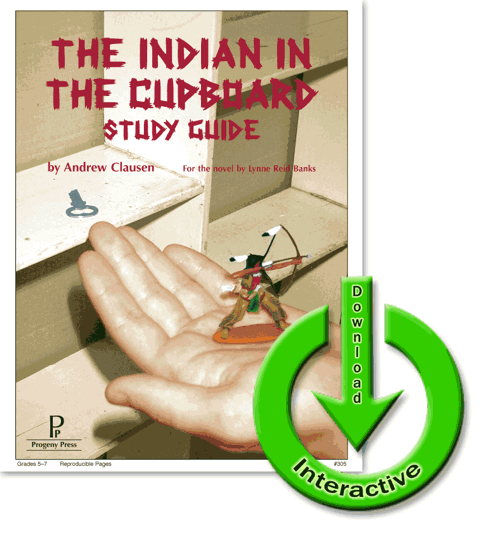
Progeny Press is one of those companies that I found when I first started homeschooling. I probably have more than a dozen of their study guides in my collection now, from the old-fashioned paperback versions to my favorites the E-Guides. In fact, I have reviewed Progeny Press several times right here on the blog! This time around we got to use Indian in the Cupboard E-Guide, which is great, since several of my kids have read and love that book!

Progeny Press study guides are absolutely, hands-down some of the best study guides out there. They are so well-organized and so easy to use. They each follow a similar format, but they all take into account the specifics of the books for which they were written. In this way, you always know what to expect, but you also know that the study guide is actually written specifically for your book. It's never a case of questions just being popped into a template as can be the case with some study guides. For The Indian in the Cupboard, the study guide format is as follows:

  • Book Synopsis
  • About the Author
  • Background Information
  • Ideas for Prereading Activities
  • For Each Group of Chapters, a selection of the following:
    • Vocabulary
    • Characterization
    • Short Answer Recall Questions
    • Point of View
    • Thinking About the Story (Comprehension Questions)
    • Dig Deeper (questions that tie the story to the Bible and a Biblical Worldview)
    • Writing Project


Literature Study Guides from a Christian Perspective {Progeny Press  Review}
Because the format is an interactive e-book, all your student has to do is type the answers directly into the PDF. It could not be any easier! If you have a lazy efficient student like my Nicholas (nearly 13), this is absolutely the ideal format for a study guide! Nicky loves to read the book, and he doesn't even really mind talking about it, but he has yet to see the benefit of doing any kind of formal literary analysis. Thank goodness for Progeny Press and their interactive guides.

Nicholas and Progeny Press

Because Nicholas is not my biggest reader (which doesn't really say much - compared to a lot of my friends' kids, he's a huge reader), I wanted a study guide for a book he'd already read. That way, there wouldn't be a ton of pressure to read the book. It would be more about experiencing the study guide. He needs help on developing his literary analysis chops, and I figured he could do that just as well with a book he'd already read. Plus, as a family we already have a great literature program that we love, so I didn't really want to take away focus from that. Basically, I gave Nicky the guide on the laptop and asked him to review the pertinent chapters (so, Chapters 1&2 to start) and then complete that part of the guide for that week.


That has worked really well. He has the book to use for reference when he needs it. 

The Dig Deeper section will be very attractive to some users as it uses Biblical passages to make the books under study more relevant for Christians.

As for us, we will continue to use Progeny Press study guides in a variety of ways. Whether it is for books my children have already read, as in this case, or for books they are reading for the first time, these remain our study guides of choice. Whether you have high schoolers reading Great Expectations, or children in elementary school reading Mr. Popper's Penguins, Progeny Press has you covered. Be sure to click the banner below to read all of the reviews!


Literature Study Guides from a Christian Perspective {Progeny Press  Review}

Crew Disclaimer

Monday, June 2, 2014

Review of Progeny Press

Progeny Press Review
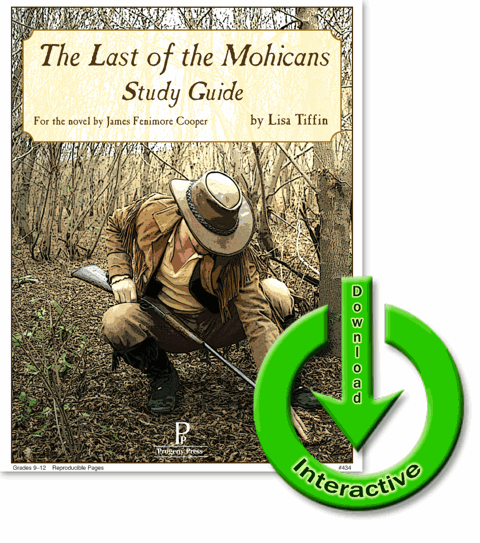
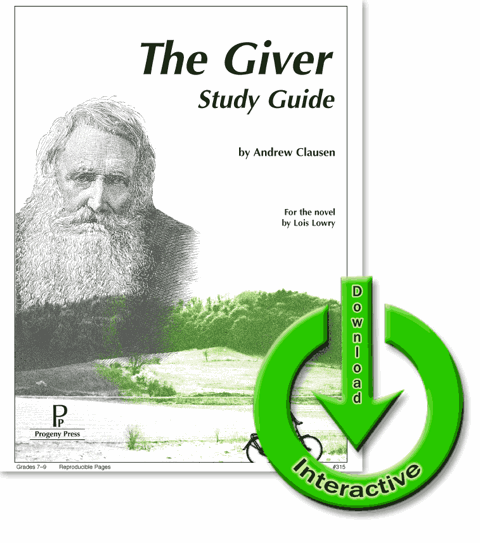
Progeny Press has been creating study guides for more years than I have been in need of study guides. In fact, they have been creating study guides for so many years that they have had to go through several technological revolutions in the meantime! My first Progeny Press study guides were printed books. Then, we progressed to pdfs. Progeny Press now offers writable pdfs. These are by far my kids' favorite iterations, and it was these versions that we reviewed. Therese (12) read The Last of the Mohicans by James Fenimore Cooper and worked on the The Last of the Mohicans ($21.99, recommended for grades 8-12) study guide, while Nicholas worked on The Giver study guide ($18.99, recommended for grades 7-9) while I read the book by Lois Lowry to all of the kids.

Progeny Press Review
If you've used a Progeny Press study guide, you have a good idea of how they work. In most cases, it would be a bad thing to say "If you've seen one, you've seen them all," but in this case I mean it as the highest compliment. The quality of these study guides never varies. Taking into consideration the ones I've used personally, the ones I've browsed online (there are samples of all of them), and the ones I've looked through in person at our homeschool store, I have never seen one of sub par quality. In fact, I don't use any other literature guides.

But enough about me. Let's talk about the two guides we received to review!

The Last of the Mohicans
This study guide is 67 pages long, and the guide is *comprehensive*. There is no fluff here. For example, By the second section (which covers Chapters 4-6), Therese was faced with this question:


I love questions like these! They make you think about the story, but they also teach you something about writing in the process. You begin to think about what makes a story - about the subtleties that really draw you in. 

Like all of the Progeny Press study guides, this one is divided up by chapters (in this case, by three chapter sections - so it is best to assign the book in three chapter "chunks"), with each section following essentially the same format:

  • Book Synopsis
  • About the Author
  • Background Information
  • Ideas for Prereading Activities
  • (Then Beginning the Chapter Activities) Vocabulary
  • Short Answer Recall Questions
  • Thinking About the Story (what I would call Comprehension Questions)
  • Dig Deeper (questions that tie the story to the Bible and a Biblical Worldview)
Some sections also have "Optional Activities."

Essentially, these study guides remind me a lot of the kind of book units that we would do in elementary-high school in my Gifted and Talented Reading/Literature classes. I *loved* those units. They took you right inside the book and had you turn it inside out. I learned to write by answering those comprehension questions and then sitting at the kitchen table while my dad went over my work and (not so gently, actually) pointed out not only my mechanical errors, but also my intellectual ones. He taught me to write using a framework just like this, and I always knew that I wanted to do the same with my kids. I just assumed that I would have to write the units. Thanks to Progeny Press, I don't have to, though. They have it all covered. You don't have to be teaching a G/T kid to use these units, but if you are, you're covered here. The material is that thorough.

So does Therese like this literature unit? Well, she likes it more than she likes other literature units! Like a lot of 12 year-olds (and a lot of G/T kids!), she's kind of lazy. She'll read college level stuff all day long, and she's happy to discuss it with me. When it comes to sitting down and writing formal answers or essays, though, she'd rather take a pass. Having said that, though, ever since Progeny Press went interactive with its pdfs, I have had far fewer complaints from her! Whereas I used to delight in handwriting all of my work because I loved using a colored pen or new notebook paper, she loves the convenience of typing. Kids these days! 

She has not been getting through this guide as quickly has I would have liked, but I have loaded her up with work in all of her classes. So, while she finished reading the book, she has been taking her time with the study guide, and I have decided that I am okay with that. I would rather her take her time and give the more thought-provoking questions the consideration that they warrant than have her dash off answers just to get the guide done. After all, I want her to be receptive to her next Progeny Press assignment!

The Giver

I have mixed feelings about an aspect of this book, but none at all about the study guide. It is excellent. In fact, I am quite impressed that the study guide is recommended for grades 7-9, even though the book is recommended for grades as young as 5th. I was, unfortunately, paying attention to the book grade recommendation when I chose the guide. It turns out that the book was really too old for my children. Fortunately, I was doing a lot of self-editing as I read it to them. It is a skill most of us have probably mastered! For those who may not have read this book, it makes several sexual references almost in passing and in a very non-sexual way. Still, none of my kids is ready for that yet, especially not my very innocent 10 year-old son for whom I intended the guide.

Still, that criticism has nothing to do with this guide which is quite appropriately "graded" at 7th-9th. I knew from the beginning that I would be working on this study guide with Nicholas. He does not have the attention span to sit through anything like this. He has the intelligence and mental ability, just not the emotional maturity and patience. So I ended up reading the book to my kids in two days. They love dystopian fiction. I let Nicholas do the vocabulary sections of the guide by himself, which is right up his alley. He likes things that have beginnings and endings and are easily quantifiable. Similarly, he has no trouble (or, rather, little trouble) with what I call the "comprehension" or short answer questions. Mostly these are just recall. I have to work with him because his first line of defense is, "I don't know" or "I forgot." Without me sitting there, he would just be content with that and close up shop.

"Thinking About the Story," "Dig Deeper," and "For Discussion" we did orally. His writing skills are not such that it would have been a huge value-add for him to do these on paper, and it was far more useful for us to talk through these questions than for him to struggle to get his thoughts down on paper. Plus, as it turned out, because I had read the book to him, I had ended up anticipating several of the questions (I didn't peek at the guide!), and we had actually already touched on several of the things raised in the guide.

So, I had two different children use the Progeny Press guides in two different ways, but each got a lot out of theirs. You don't have to write the answers to everything in these guides for them to be very useful tools! I think that's a really important thing to realize. As with all things homeschooling, there is not a wrong way to do things. Different approaches will work with different children. I absolutely love these guides. They are very reminiscent, to me, of something from my public school days that worked *really* well. (Caveat: I had a stellar public school education in a large district in a large city.) Progeny Press sells a plethora of guides for all ages from the youngest elementary grades through high school, so there is sure to be one that suits your needs. To see how guides at all levels can be used, click the banner below.


Click to read Crew Reviews
Crew Disclaimer

Tuesday, October 13, 2015

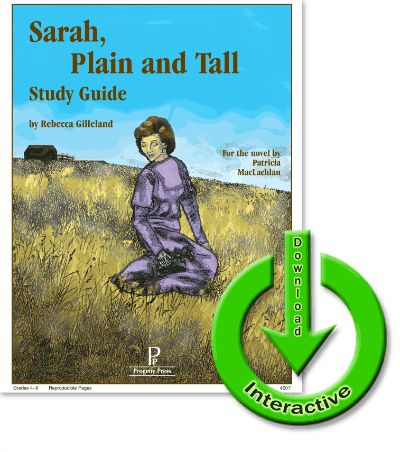
Review of Progeny Press' Sarah Plain and Tall

Progeny Press Review

Progeny Press study guides are the gold standard in literature guides that have a Christian worldview. We have been blessed to review Progeny Press before. We have reviewed Beowulf, The Last of the Mohicans and The Giver, and Pride and Prejudice. Needless to say, this is a product line with which we are familiar and which we really enjoy. For this review, Mary-Catherine used the study guide for Sarah, Plain and Tall (recommended for Upper Elementary, 3rd-6th Grade).

Progeny Press Review
Like all Progeny Press study guides, Sarah, Plain and Tall is composed of multiple parts. In this case:
  • Synopsis
  • About the Author
  • Background Information
  • Before-You-Read Activities
  • As You Read Assignment
  • Chapter Assignments
    • Vocabulary
    • Short answer questions of various types (could include straight up short answer, compare and contrast, figures of speech, and more
  • After-You-Read Activities
  • Additional Resources
There is enough consistency in this literature guide that it will remind you of other Progeny Press guides you may have seen or done, but enough originality that you don't feel that it is just more of the same. For this guide, there are three chapter groupings (that is the nine chapters of the book, Sarah, Plain and Tall, are broken into three groupings for the purpose of the literature guide), and that is perfect for the book and for the age.

Mary-Catherine (10) and the Guide

Mary-Catherine has read Sarah, Plain and Tall before, but she has never done any kind of study guide, so I thought that this was a good way to introduce her to the concept. The book is way below her actual reading level (even though it is right in line with her grade level), but because she is not used to the idea of "doing" literature, the study guide is just right for her ability level. 

First I had to decide whether to print the study guide and have her do it the traditional (pen and paper) way or have her do it on the computer (since Progeny Press guides are writable PDFs). I opted to let her do it on the computer. The novelty approach always helps when you're having your kids do something they're not too sure about.

Because Mary-Catherine reads so fast, and because this is a book she first read many years ago, there was no way that I was going to be able to confine her to, for example, Chapters 1-3, so I just let her re-read the book all at once and then let her work on the guide at her own pace. The vocabulary exercises, while a new idea to her, didn't present any kind of challenge; however, they were exactly the kind of exercise she should be doing. For example, the directions for the following asked her to find two synonyms for the underlined word:


It's completely age and level appropriate. It gets her using outside resources (dictionary and thesaurus) and has her examine words and sentences more in-depth.

The short answer questions are similarly right on target. A kid like Mary-Catherine who reads voraciously doesn't necessarily take time to dissect things like setting (who among us does at that age, really, unless forced to). This study guide led her to do so in a gentle and age-appropriate way. It ended up being the perfect way to begin talking about literature-esque terms like "setting." 


Further, because she could type in her answers, she didn't have to be worried about things like handwriting, having enough room on the page, etc. The typing is really freeing for some kids (especially those who write really big!). 

There are a nice assortment of before you read and after you read activities, too, for people who like that kind of thing. As for me, I really embrace these guides for the pure literature aspect. They are solid scholarship in that regard. For the more creative homeschooler, though, you'll find everything you could desire. All of your hands-on goodness is here! The guides cater to every type of learner.

Once again, I wholeheartedly endorse Progeny Press literature guides. Their range is impressive and they are perfect for those who want their kids to delve more fully into the literature they read. Mary-Catherine enjoyed hers, and I know we'll be back for more! Be sure to click the banner below to read about all of the other guides that Crew members got to use in their homes!


Progeny Press Review

Crew Disclaimer

Sunday, March 18, 2012

Review of Progeny Press Literature Guids

As a homeschooling mom who was public schooled, I sometimes experience conflict about what I did in school versus what I have my children do.  I have no desire to replicate the public school experience at home (although I received a superior education), but there were things about my education that I feel my children are missing.  Specifically, I learned to write well from reading books and then answering comprehension questions about them.  Thanks to what I now call after-schooling, my father used literature and these questions as a jumping off point to teach me to write essays.  I learned how to analyze literature by writing.

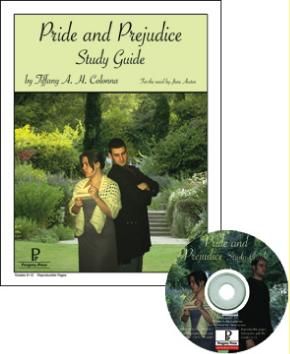
My daughter reads voraciously, just like I did at her age.  Because of that, I have never emphasized answering questions and analyzing literature as much as I would have if she struggled with reading (which actually kind of sounds like a backward approach now that I think about it.  However, now that she is in middle school, it has become important to me that she knows how to read and properly analyze literature.  Making this decision is only one step of the process, though.  The next step is choosing the curriculum for the purpose.  While I could write the questions and/or book units myself, I would rather not expend the effort!  Fortunately, I do not have to. Progeny Press has done it for me.

Progeny Press has offered amazing literature units for many years, but their new interactive pdf guides are amazing.  With these guides, your student can type directly on the pdf and then print it out.  Also, more than one child in your family can use the same guide without having to make additional copies.  Each one just saves the guide under his own name.  To see an example of how the interactive guides work, navigate here.

In exchange for my review, I received two of Progeny Press' interactive guides free.  We used Pride and Prejudice in our homeschool.

Each of Progeny Press' study guides is assembled in essentially the same way: a synopsis of the book, a summary of the author's life, and chapter questions.  Each group of chapters has vocabulary (matching a word to its definition and using the word in an original sentence) and questions.  The questions are not merely "What does Elizabeth Bennett say when Mr. Darcy is rude to her?" or the like. Instead, the questions ask the reader to consider everything from irony to foreshadowing (explanations accompany the questions), finding examples in the text, and asking what certain statements or events in the book reveal about a character? The questions lead a student to a deeper understanding and appreciation of the text.  Finally, at the end of the guide there are multiple essay question options (eight for Pride and Prejudice) for parents to assign to their students, followed by related books of interest and (in the case of Pride and Prejudice) a list of movie adaptations.

I can't say enough good things about these study guides.  I loved them when they were just bound editions of literature studies.  My daughter did not.  There was a lot of writing for her to do, and given that she is younger in years than in reading/comprehension ability, the writing really was onerous for her.  The interactive pdf version of the guide changes everything.  Now, instead of having to hand write everything, all she has to do is type in the fields provided.  She and I are both thrilled! Of course, the thing that really sets Progeny Press apart is its Christian emphasis.  Biblical references are always included, and students are asked to analyze the literature in light of Christian values.  I actually think that a secular homeschooler could use these guides quite happily, just by eliminating the Christian questions.  Christians, of course, will love how any literature is made relevant to their life in Christ.

Progeny Press offers over 100 literature guides, for ages ranging from 5-18 and up.  The entire catalog of titles can be seen here.  The guides range in price from $10.99-$27.99, with CD and print versions running a couple of dollars more expensive than pdf downloads.  One thing that should be noted is that the emailed pdfs are not an automatic download.  They are processed manually and emailed usually a day later.  Progeny Press does charge a $3.00 processing fee for the email downloads, however, the charge is the same whether you order one guide or ten at a given time.  Therefore, if you want more than one guide, make sure to order them at the same time!

My house is definitely a Progeny Press house.  To see other opinions, view the Crew blog.

Wednesday, July 18, 2018

Review of Progeny Press


If you have been reading my blog for any length of time, you know that we have used and loved Progeny Press almost since we began homeschooling (2007!). As a piece of trivia, Progeny Press began with 18 study guides in 1993 and has 115 guides currently. I have also been lucky to have reviewed it several times before. You can read those six reviews here. This time around, we got to review The Scavengers - eGuide. Like all Progeny Press study guides, this one follows a similar format. The study guide is 73 pages, including an answer key. It contains background information, pre-reading activities, vocabulary, content questions, what I call comprehension questions (so, digging deeper and critical thinking short essay-style questions), and activities. There is a wide enough variety that a student can either complete the whole study guide (which I would think is preferred), or pick and choose which parts suit their style. For instance, I have one child who loves to write, so would eagerly tackle all of the writing/short-essay style questions, but who loathes anything that looks like a hands-on craft or activity. I have another child who is dysgraphic*, so doesn't necessarily embrace writing, but who is very hands-on and loves activities (*note that dysgraphia isn't nearly as big a problem with Progeny Press e-Guides, as students can type directly into a pdf!).


Mary-Catherine (13) was my tester for this study guide. After I bought The Scavengers for her to read, she inhaled the book in one day. Well. That's not usually the best way to go about doing a study guide. It generally works better, from my point of view, to read a section and then do the accompanying study guide section, but I have never once ordered my kids to stop reading, so we dealt with it. Because she had already read the whole book, Mary-Catherine was allowed to complete the study guide at her own pace; no reading before writing necessary!

Mary-Catherine really enjoys words, so it was no surprise to me that she thoroughly enjoyed completing the vocabulary activities. She also liked the short answer questions. Her enjoyment of the study guide was confirmed when the first "Thinking About the Story" activity talked about word play, like alliteration. It's always exciting to see something you know a lot about pop up in your curriculum, so she eagerly went after this section, too. The longer essay-type questions are a bit more challenging, but because the book was below her current reading level, they didn't present as much of a challenge as they otherwise might have. One reason I love these study guides is because they force me to make my kids struggle with literature (by which I mean it forces them to confront issues in books and to wrestle with the meanings and implications). It's something I do naturally, and I take it far too much for granted that my kids do it, too. They don't necessarily, though, so Progeny Press always holds my feet to the fire!

Like every Progeny Press study guide we have ever used, beginning with the paper versions in 2007 and right to the pdfs today, this one was excellent. I would recommend any of their study guides to anyone.

If you have kids younger or older than Mary-Catherine, be sure to click the graphic below to read more reviews, including reviews of study guides for the youngest readers through high school.


New Study Guides for Literature From a Christian Perspective {Progeny Press Reviews}

Tuesday, September 12, 2017

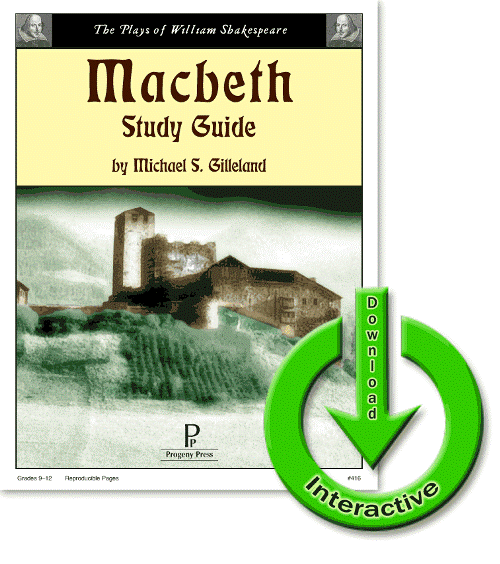
Review of Progeny Press's Macbeth E-Guide

Progeny Press

Over the past ten years of homeschooling, we have completed more Progeny Press study guides than I can count, many of which I was lucky enough to get through the Homeschool Review Crew. You can read my past reviews here. This time around, we delved into the murky world of Macbeth with the Macbeth E-Guide (Grades 9-12)! 

Macbeth - E-Guide
The Macbeth E-Guide is comprised of the following parts:

  • Note to Instructor
  • A Special Note on Shakespeare's Plays
  • Synopsis
  • Background Information
  • About the Author
  • Suggestions for Prereading Activities
  • Act I
  • Act II
  • Act III
  • Act IV
  • Act V
  • Overview
  • Writing Projects
  • Additional Resources
  • Answer Key (in a separate file)

The Note to Instructor explains how Progeny Press study guides work, including expected pacing. The note on Shakespeare's Plays recommends a particular edition for ease of use and also points out that the plays were originally intended to be read aloud; hence, an audio recording can enhance the experience. Next comes a two-page synopsis and one page of Background Information, relating the play's historical basis. The About the Author section refers to Shakespeare's Bio, and not that of the Study Guide author (hey - I wasn't sure which it would be, so I wasn't sure if anyone else had the same question!). Among the Suggestions for Prereading Activities are background research work on the time period during which Macbeth takes place, map work on Scotland, reading Machiavelli's The Prince, and other topical and interesting activities. 

Then comes the meat of the study guide. For each act of the play, the study guide follows the same format.

  • Vocabulary 
  • Scrambled Quotation
  • General Questions (short answer)
  • Analysis (longer answer)
  • Dig Deeper (more of an essay with more analysis required)
  • Extra Activities (could be formal essays, art projects, scenes to act out, and more)
The exception to the above format is that Act IV includes Discussion Questions. Following Act V, there are 15 final questions that tie the entire play together. They can be done either as oral discussion questions or as essay questions. They are intended for the student to reflect on the play as a whole.

At the end of the study guide are eight Writing Projects. These make great final essays, demonstrating mastery of the subject matter of Macbeth. They result in longer papers than the questions just preceding. Additional Resources round out the study guide. This is a page listing other plays by Shakespeare, books about him, and Shakespeare videos like Emma Thompson's Much Ado About Nothing from 1993. 

Nicholas and Macbeth

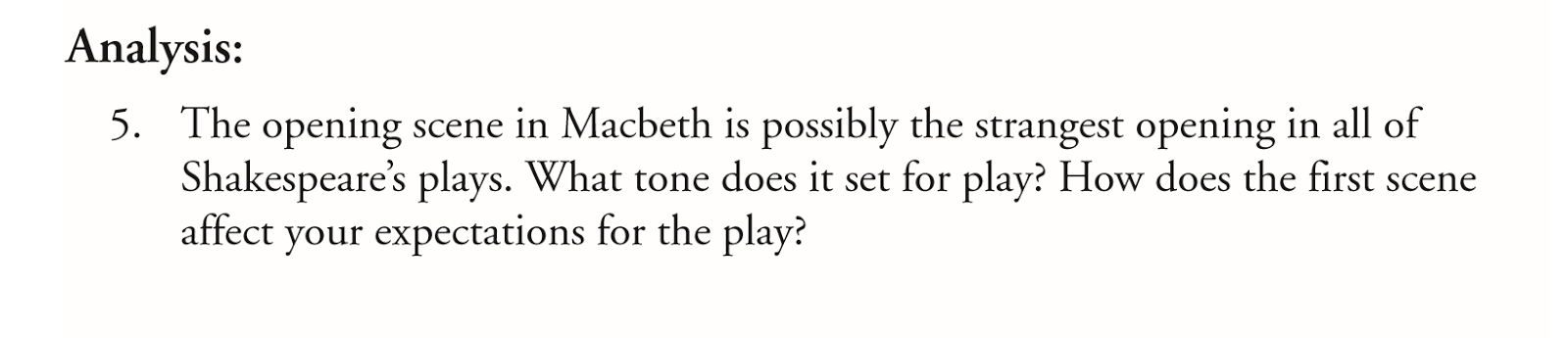
The target age for Macbeth is high school, so I had originally decided that Nicholas (14) would be the one to use this study guide, as he is a freshman in high school. However, since he doesn't love reading for school, and since Macbeth is a play, I decided that I would read it to all of my younger three children (Nicholas and my 12 year-old twins). It's never too early for Shakespeare! Proceeding in this manner, I read Act I of the play, and then a funny thing happened. As I was beginning to go through the study guide with Nicky, the twins were piping up with the answers. In that way, we ended up doing most of the study guide orally. Now, because Nicky is the one in high school, he did end up with a couple of paper assignments, but it was wonderful being able to use the study guide to generate discussion questions among the four of us. A question like:

is much more interesting when multiple people can share their opinions and discuss in a family group!

The essay questions were right on target for Nicholas's age. They were not too difficult, but they were far from too easy. In the past, I have found some of Progeny Press's elementary study guides a little too elementary for my children, but I have always enjoyed their high school guides very much. This one is certainly no exception. The Answer Key is thorough and provides you with everything you need to know to accurately evaluate your child's responses.

Homeschool Review Crew members reviewed several different Progeny Press guides, so be sure to click the banner below to read all of the reviews!

Study Guides for Literature {Progeny Press Reviews}

Crew Disclaimer