Pages

Friday, August 17, 2012

Review of Spelling City


While my kids have been using Spelling City for quite awhile, we have been using the premium features for the past six weeks or so.  We love Spelling City! Perhaps, like me, you have wondered if upgrading to the premium version of the site is worth it.  In my opinion, it is.

While you can get plenty of benefit from the free site, when you upgrade to the premium site you gain access to so many more features.  While the extra games are great, it is the definition, sentence, and paragraph work that really creates the biggest value.  In this way, Spelling City becomes just as much about vocabulary and writing as it is about spelling.  Also, if you are a homeschooling family, the ability to create lists giving different children different word lists and assignments is huge.  It takes all the guesswork out of creating a spelling curriculum.  You don't even have to find the lists - there are over 42,000 words on Spelling City, and they are composed into more lists than I can name.  There are topical lists, subject lists, sight word lists, geography lists, sound-alike lists and more.  If you want to make your own lists, that is easy to do.

Further, although ads don't bother some parents, the ability to use Spelling City ad-free may be worth the price of upgrading to some parents.  Really, the premium version of Spelling City has features to appeal to everyone, as can be seen in this graphic.
 While we always use the products we are given to review, Spelling City is one that we will continue to use on a nearly daily basis and, having been able to experience the premium version, I know that I will renew it when my time is up. Spelling City is something that my kids really enjoy doing.  I don't think that they actually realize that it is school.  Due to that lack of realization, we don't have to do Spelling City during school time - it can be moved to free play computer time, and *that* means...more net school time!

For my younger children (7), I used premade lists on Spelling City, primarily because I liked being able to choose words that are considered second grade words.  One always wonders if her children are where she thinks they are! For my older children, I entered words that I had already selected into Spelling City for them to study.  By the end of the review period, though, I was using premade lists for them, too.  There are just so many to choose from, and the themes (i.e., Geography) are so fun!

For each of my children, I entered specific information about their lists and assignments into their Spelling City accounts (they log in as themselves and I am then able to check their individual progress - a truly awesome feature of the premium subscription, and the reason I will be renewing) for them to use independently. It made my "job" as their spelling instructor almost irrelevant (which is great!).


At only$29.99 per year for up to five students, Spelling City is a great deal for kids who respond well to computer-based learning.  Because everything you need for a spelling curriculum is included, the price essentially break down to $6.00 per year, per student (assuming you use it with five children).  I really do recommend Spelling City premium.  All of my children from 7-11 have so much fun with it (and, yes, they absolutely do learn their spelling lessons!).

As always, check out the Crew blog for other experiences!


Photobucket

Disclaimer: I received a year's subscription to Spelling City Premium free in exchange for my review.  My children have gained spelling knowledge, but I have received no other compensation.


Review of Economics for Everybody


As the name of this series suggests, Economics for Everybody truly is for...everybody! I have a limited background in economics (only insofar as it affected by Political Science work in graduate school), and no background in biblical economics at all.  Of course, I have always believed that the current problems of scarcity and inequality in the world are the result of the Fall (as, of course, are all problems in the world!), but to have it presented as so in an economics course is so refreshing. Economists have ways of explaining inequalities, etc. (often using ridiculously convoluted equations to prove their theories which one would need a Ph.D. to understand...oh, wait: I have one of those and it doesn't actually help!), but very few understand or accept the root cause: man's sinful nature and rejection of God! Lecture 2 of this course makes it very clear very quickly that this course does accept that premise from the start.


This Biblical thread runs through the whole program, but it should not be assumed that the material is any less informative or rigorous for that fact (I know I am not the only person who has had experience with Biblical curriculum that is more about the Bible than, for example, English or math).  As the list of lessons shows, all the typical components of an Economics course are present:
List of Lessons:
1. And God Created Economics | Stewardship in God’s Image – What is Economics? – God’s Attributes & Actions – Man in God’s Image – Creation Mandate – Stewardship – Why Study Economics – Missionary Impact


2. The Economic Problem of Sin | Law, Liberty & Government – The Fall of Man & Scarcity – Impact of Fall on Stewardship & Work – Grace of Law – Economic Aspects of 10 Commandments – Civil Government – Liberty vs. Tyranny – Theology to Anthropology to Politics to Economics – Trade -
3. The Path from Work to Wealth | Production, Property & Tools – What is Wealth? – Principles That Lead to Wealth – Work – Production – Ownership & Private Property – Land, Labor & Capital – Savings & Capital Accumulation – Division of Labor – Tools – Mass Production – Lower Prices & Increased Purchasing Power
4. The Route From Scarcity to Plenty | Money, Markets & Trade – Famines, Scarcity & Prosperity – Value – Economic Demand – Markets – Free Trade – Money – Laws of Supply & Demand – Price – Marginal Utility – Impact on Prices – Greater Selection of Goods & Services at Lower Prices
5. The Role of the Entrepreneur | Capital, Calculation & Profit - What is an Entrepreneur? – Importance of Capital – Economic Calculation – Job Creation – Technology – Profit – Competition – Self-balancing Free Market
6. A Tale of Two Theologies, Part 1 | From God to Politics - Consequences of Economics – 19th-century England vs. 20th-century Soviet Union & Impact on Christianity – Comparison of Christianity vs. Atheism – Two Systems at War – Theologies – Anthropologies – Political Philosophies – Political Systems
7. A Tale of Two Theologies, Part 2 | Economic Philosophies & Systems - Comparison between Christian & Atheistic Economic Philosophies – Private vs. Public Ownership of Property – Free Market vs. Command & Control/Socialistic – Interventionism – Freedom & Growth of Christianity
8. Government Intervention | Basic Principles & Education – German Socialism in WWI – North Star Principle: Biblical Stewardship – Intervention & Stewardship – Areas of Interventionism – Quick History of U.S. & Economics – U.S. Educational Policy & Stewardship
9. The Two Mysteries of Monetary Policy | Inflation & Depressions – Two Mysteries: Devaluation of Dollar and The Great Depression – What is Money? – Government & Banks – Interest Rates – Federal Reserve – Inflation & Stealing – Interventionist Monetary Policy & Stewardship – Inflation leads to Boom & Bust Cycle – Influence of Central Bank – Great Depression – Govt Policies & Stewardship
10. The Welfare & Corporate States of America | The Costs of Redistribution– The Welfare State – Biblical View – Brief History – Problems of Intervention – Growth of Welfare State – Christian Questions – The Corporate State – Cronyism – Politics and Business – Government Spending – Government Taxation – Government Borrowing – Impact on Stewardship
11. Economics Has Consequences | The Real Effects of Sin – North & South Korea – Impact of Economics on Christianity – Sin & Economics – Socialism: Scarcity & Police State – Gradual Socialism/Interventionism: Nation of Rent Seekers – Regulation & Bureaucracy – Free Markets – Economics & Religious Freedom
12. Kingdom Economics – Genesis 3:15 & The Serpent – Moses & Slavery – Sack of Rome and Augustine’s City of God – Hitler’s Mein Kampf – Gradual Socialism & Christianity – Liberty & Economics – The Kingdom and the Future

Presented (although not created or written) in segments of 15-20 minutes by R.C. Sproul, Jr., a very easy man to listen to, this is a course for the whole family, your homeschool, or your church.  Replete with inserted videos and photos, the course is a visual, as well as an audio, treat.  Further, it comes with a 250 page study guide containing Biblical readings, further discussion, and more.

Economics for Everybody is currently available on DVD or download for $36.00.  

Disclaimer: I received Economics for Everybody free from the publisher in exchange for my honest review.  I received no other compensation.
Disclaimer #2: As a Catholic, I disagree with some of the positions taken by R.C. Sproul, Jr.  There is nothing in this course that I find personally objectionable.

Wednesday, August 15, 2012

Review of Vocab Videos


 Through my participation on the TOS Crew, I was given a year long subscription to Vocab Videos, a website composed of videos designed to illustrate the meanings of 500 SAT vocabulary words in a way meaningful to SAT-aged students.  Practically, this means that words are presented by way of short (less than one minutes) sketches designed to illustrate visually the meaning of the word.  The videos are short, pithy, and memorable.


Caveat: these are secular videos, and they do contain instances of "Oh my God" and "Shut up." I know many homeschoolers would disagree with me, but I let my seven year-olds watch these videos with my eldest daughter, and I didn't feel like it was a problem. I would strongly urge any parent to watch them first before showing them to any child!


In addition to the videos, there is a plethora of other resources for users of Vocab Videos.  These include a complete glossary,


BELLIGERENT eager to fight
BEMUSE to confuse, stun, or stump
BENEVOLENT inclined to perform kind acts
BENIGN kind; beneficial
BERATE to criticize severely or angrily
BOISTEROUS noisy; disorderly
BOLSTER to support; to reinforce

a grouping of all words by word type (like synonyms),

Definition Groups
Bad Blood
ABHOR to hate
ACRIMONY hostility
ANIMOSITY bitter hostility
ANTAGONISTIC hostile
CONTEMPT a lack of respect and intense dislike
DISDAIN intense dislike

worksheets, and quizzes.


Families could use Vocab Videos in different ways.  So far, we have not used the quizzes or worksheets.  Instead, my daughter watches the videos and I then ask her what the words mean.  Very simple.  You can use as many or as few of the site resources as desired (including digital flashcards).  I think this product would be excellent as SAT prep.  Although Therese is only 11, she will be taking the PSAT next year, and I know that early exposure to all of these great words is sure to help her score.  Plus, because there is such a strong visual component to Vocab Videos, even if she gets nervous on the test, she will likely be able to recall the *context* of a given word giving her a huge advantage.

Pricing for Vocab Videos is simple, although it might not make sense for some families.  In essence, homeschoolers fall under the category of "Small" with up to 20 students.  It might make great sense for a coop, though.  At this price it is kind of pricey for an individual family, but if you have a visual learner, it is probably worth it.  This approach is just so much fun!


We really like Vocab Videos, but this is one where you will definitely want to check out the other Crew reviews.  The format and the content of the videos have a huge impact on whether one likes them or not.


Photobucket

Disclaimer: I received a free subscription to Vocab Videos for the purposes of review.  I received no other compensation (apart from some laughs).

Wednesday, August 8, 2012

Review of Math Made Easy


As a member of the TOS Crew, I was given the opportunity to review Math Made Easy's Multiplication Teaching and Learning Made Easy.  Recommended primarily for 3rd and 4th graders (although certainly beneficial to older children who need to be drilled in multiplication facts), this program consists of lesson plans, a pretest, six weeks of daily activity sheets, a post test, multiplication games, and flash cards, all contained within a modestly sized comb bound book.

 These sample worksheets give a very good idea of the tone of the program.  This is a very basic, bare bones approach to learning multiplication facts.  It reminds me of the kind of worksheets that I had as a kid in school, which is not a detriment: many homeschooled children do exceptionally well with such a presentation.

Some homeschooled kids, though, especially those who don't really have an affinity for math do not respond well to the worksheet approach.  Granted, this program includes coloring activities, too, but it still remains basically just a worksheet drill-n-kill.  It is probably for this reason that my 2nd grade twins (my only children who did not know their facts when we got this program) didn't respond to it very well.  We spent several weeks using this program exclusively, but then began to use another, interactive, program and their retention of facts increased dramatically.  It is possible that they


experienced greater success with the other program because they are more visual learners (I think our computer-based culture is probably actually creating more visual learners).

What this program does differently than other worksheet-based approaches is to begin with the premise of eliminating certain facts right off the bat (zeros, ones, tens, elevens - all the easy ones), and then teaching the others in pairs (i.e., 3x2 is the same as 2x3).  The author posits this as a new and different way to teach multiplication. My main problem is that I don't think it is new.  This is the way I learned multiplication 30 years ago, and it is the way I taught the facts to my two older children.

Perhaps for parents who are even less math-able than I, this approach will seem novel enough to justify the $24.95 price tag, but for my money, there are many less expensive ways to teach the facts.  Just because Math Made Easy was not the right fit for our family does not mean that it is not perfect for yours! To see other Crewbies' experiences with this program, be sure to read the Crew blog.


Photobucket

Disclaimer: I received Multiplication Teaching and Learning Made Easy free in exchange for my review.  I received no other compensation.

Tuesday, August 7, 2012

Review of Create Better Writers


Writing is often the bane of a homeschool mom's existence.  Even if one is a good writer herself, it is sometimes hard to translate that skill into teachable writing.  Fortunately, there are companies like Create Better Writers to help out.

Create Better Writers is the brainchild of a veteran writing teacher who, finding that the public school curricula from which he was teaching was simply inadequate, set about creating his own.  With the input of homeschool teachers, David Dye came up with a program that has a proven success record.  In fact, he actually became a trainer of public school writing teachers.

As part of the Crew, I was able to review How to Teach the Paragraph, The Homeschool Writing Action Plan and How to Teach the Five Paragraph Essay.  The Homeschool Writing Action Plan is organized into three parts: the writing action plan summary, a pacing guide, and a roadmap.  The best thing about this book is that you are not obligated to use Create Better Writers' program.  The Action Plan will help you teach writing from any curriculum.  I began my foray into Create Better Writers by reading this book.

The Action Plan Summary immediately tells a parent/teacher what they should teach their child writing-wise and when.  It tells parents how long each aspect of writing instruction should take, based on how old the child is when learning it.  Along the way, it offers the resources of Create Better Writers so you know what to use and when (assuming you choose their curriculum).  Again, though, the directions are so clear that you don't have to use CBW to teach writing.  You will learn when to teach sentences, paragraphs, essays, etc., and how to accomplish the teaching, with just this one book.  Think of it as writing lesson plans.

How to Teach the Five Paragraph Essay is more nuts and bolts.  The format of the book is as follows:


  1. List of Steps
  2. Sample Pacing Charts
  3. Detailed Lesson Plan
  4. Plan for Total Mastery
  5. Bells and Whistles
  6. The Next Level
The premise of the book is that by learning how to write the five paragraph essay, a student will be able to apply the skill to any kind of writing (persuasive, narrative, etc.) in any situation.  The goal is to teach this skill, not to teach a particular style of writing.

I think this resource is a valuable one.  I did use it with my eldest daughter, and I liked terms like "Terrific Transitions" and "Classy Conclusions." I think catchphrases like this can really help cement ideas with kids.  The best endorsement that I can give this book is that it teaches writing like I teach writing.  No, I don't have an MEd like the author, but I was gifted with a father who taught me how to write at a very young age, excellent teachers, and, I think, a natural ability.  I have problems with programs that focus on creative writing, free writing, etc. while ignoring the basics.  Like it or not, the five paragraph essay is the basics.  Even in my dissertation, I was aware of the basic structure of an essay.  In essence, then, whether a student is writing a two-page essay or a 300 page dissertation, the knowledge of this basic structure is key to writing success.

If you need a writing program that teaches nothing but the skills needed to write a great academic essay (which, to me, should be the primary goal of any writing program), Create Better Writers is the program for you.  The entire program - everything you will ever need to teach your students writing - can be had for less than $100.  How to Teach the Five Paragraph Essay costs $17.95.  How to Teach the Paragraph is $7.95.  The Homeschool Writing Action Plan costs $15.95.  The best deal is the Homeschool Bundle for $84.95.  

The Package Contains


You really will not have to buy another writing program. Best of all, your kids will be able to write!

These books taught me that everything believe about teaching writing is correct.  To see what other Crew members thought, see the Crew blog.


Photobucket

Disclaimer: I received these ebooks free in exchange for my review.  I received no other compensation.

Wednesday, August 1, 2012

Review of SchoolhouseTeachers.com

SchoolhouseTeachers.com may be the new kid on the block in terms of online homeschool resources, but it is one of the most complete and, because of the inclusion of the famous TOS planners, it is definitely the best value!


Describing everything to be had with a membership to SchoolhouseTeachers.com is harder than emptying the ocean one spoonful at a time, so I'm going to lead with a bulleted list and follow with my favorite parts of the site.  For some clue to how much is available on this site, be sure to look at the sample pages.  They include only a few of the homeschooling heavy-hitters, some of whom are:


A subscription to SchoolhouseTeachers.com includes the following and much, much more. It truly is impossible to overstate how much you get with this site:


Essentially, for what you used to pay for a print copy of TOS' magazine, you now have access to the magazine and so much more.  Everyone has their favorite features of SchoolhouseTeachers.com.  Mine are the following:


  • THE PLANNERS!! If you're anything like me, you have a love/hate relationship with the TOS planners.  I love them because they have every single possible form I could ever want, and I hate them because they are a huge source of temptation on the years I really shouldn't buy them! Fortunately, I won't ever have to feel that way again.  Every single TOS planner is included in your SchoolhouseTeachers subscription.  The family includes the big kahuna for all moms, special learners, primary, intermediate, and high school.  That's five huge planners free with your subscription!

  • Figures in History: If you've seen and appreciated those books with historical figures to cut out and join with brads, then this feature will be one of your favorites, just as it is one of mine.  Cathy Diez-Luckie, the creator of Figures in Motion offers a history lesson each month that includes one of her amazing figures.  These lessons are not to be missed (be sure to check out the sample pages to see one month's lesson!).
  • Daily grammar, math, and writing lessons.  Yep, daily lessons by some of the top names in home education.  The lessons are short and to the point and are perfect for days when you just don't know what to do.  Even if you don't use them often, just knowing they are there is like a safety net you always have.
  • A chemistry course.  The creator of Friendly Chemistry offers SchoolhouseTeachers members the benefit of his knowledge and experience with his Friendly Chemistry course.  Make no mistake, this is real chemistry-- and it's included in your subscription! For example, this month's lesson covers the following:
These are only a few of the amazing features you will receive with your subscription.  This is one time when it is essential to visit the Crew blog in order to see more reviews.  There are so many things at SchoolhouseTeachers.com that every member of the Crew has likely highlighted something different!


A subscription to SchoolhouseTeachers.com costs $5.95 per month (after your first month,which costs only $1.00), but if you join HSLDA (and who doesn't want to join HSLDA?), you get a year's membership free.  Simply see this page!

Photobucket

Disclaimer: I received a year's subscription to SchoolhouseTeachers.com in exchange for my review.  I received no other compensation.

Tuesday, July 31, 2012

Review of Zane Education


For the past couple of months, we have been using Zane Education in our homeschool.  Zane is one of those products that I am thrilled to have received free for review, because I likely would not have found out about it otherwise! Explaining Zane is a little difficult, but essentially, it is a website composed of 1,600 subtitled online educational videos accompanied by study guides, lesson plans, and online quizzes.  Topics covered range from history to science to art.  Each video is a few minutes long, but multiple videos are compiled under specific topics. For an idea of what the videos are like, see the free daily video here.  The best way I can think of to describe the videos is that they are reminiscent of the film strips those of us in our 30s grew up with in school.  In fact, they make me a little nostalgic!

What sets Zane apart from other websites that host educational videos is the subtitling.  Recognizing that seeing words fixes them in children's minds, all of Zane's 1,600 videos are subtitled.  Thus, as they are narrated, children actually see the words on the screen.  Zane calls this innovation "The Missing Piece." Because children have different learning styles, unsubtitled videos that cater primarily to auditory learners miss the mark with more visual learners.  Subtitles address that disparity.


Unlike many companies whose main focus is either homeschool or public school, Zane has arranged its website to fill the needs of all kinds of scholars.  Although it covers topics that some Christian homeschoolers may be squeamish about (evolution), the Gold subscription includes a 420 page guide on Christian Home Learning which explains how the Zane videos can be used in way that is completely consonant with Christianity.  This factor makes this one of my favorite programs: it is equally friendly to Catholic, Protestant, and secular homeschoolers alike.  Parents are provided with the tools necessary to make the program work best for their families.

The best way to understand all that Zane offers is to read their "Getting Started Guide." It addresses all potential questions and concerns.  It will also help to ensure that you get the most out of your Zane subscription.


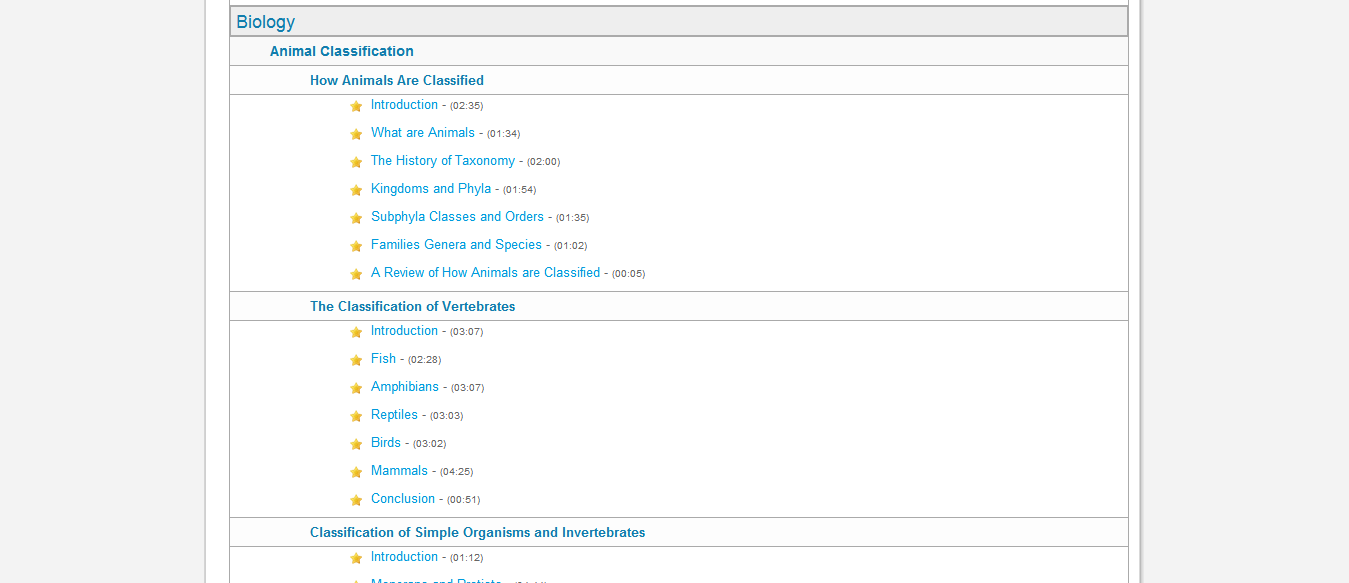
Because the ways a family could use Zane are almost unlimited, I will just mention how our family is using it.  So far, we are working our way through the Art History and Life Sciences sections of the site.  I hook the computer up to the TV so that all of my kids can see, and then play a series of videos (the picture below shows some of the videos we have used, as indicated by the yellow stars).


After watching the videos, we would go through and do the quiz together.  The quizzes do an excellent job of assessing whether or not we paid attention and learned! Videos are accompanied by lesson plans which are often short, but packed with relevant information such as glossary terms and discussion sections.

I could actually continue to rave about Zane, but you really have to experience it to believe it.  Further, Zane's Facebook Page is an excellent place to find out more about how to use the program.  Fortunately, they also have a free subscription option:


For those wanting the full subscription (and, trust me, you'll want the full subscription!), information on all the options is shown below.


If you're interested, though, time is of the essence! By using the code ZE725HSM you can get 35% off a 12 month bronze, silver, or gold membership.  That adds up to some serious savings!

We absolutely love Zane.  To see what other Crew members had to say, be sure to read the Crew blog.


Photobucket


Disclaimer: I received a free subscription to Zane in exchange for my review.  I'm glad the review is done now so I can go back to watching Zane videos!