Pages

Thursday, December 15, 2011

Review of The World's Greatest Stories


When I received this CD free for my review, I was expecting to love it.  My kids really enjoy Bible stories, and I loved the thought of them being able to listen to them in the car or on their MP3 players.  Unfortunately, this CD received the support of only one of my four children.

The World's Greatest Stories are stories read word-for-word from the Bible (either KJV or NIV) by George Sarris.  What makes them different is the dramatic way in which they are read.  There are currently six CDs available; my family listened to The Prophets.  For only $7.95 per CD, you likely won't be disappointed if you choose to buy these recordings, but they are not for everyone.

I have always been of the opinion that the Bible (with the exception of some of the "begats" and the Laws) is exciting reading in its own right.  It doesn't require dramatization.  I have never had to urge my children to listen to Bible stories, and they have never (I don't think!) found them boring.  The problem with this CD, though, is that the reading (the actor actually memorizes the stories before recording them) is so over-the-top that my children actually laughed too hard to hear it.  Stories that they knew suddenly became almost farcical.  I understood why they laughed, but I was sad that that was their reaction. Only my 7 year-old son enjoyed the CD.

The best thing to do if you're interested in the CDs is to listen to samples of them on the website.  That way, you can be sure that they are right for your family.

Hey, my opinion is just that: mine.  To hear other opinions (and a ton of people really love this product!), read the Crew blog.

Review of I See Cards - Fractazmic

I was thrilled to receive a copy of I See Cards' Fractazmic free in exchange for my review for several reasons.  First, I See Cards' Pyramath was the first Crew review I read last year (I didn't review the product).  Based on the Crew reviews, I bought Pyramath.  I have since gifted it multiple times.  When I saw a new I See Cards game, I knew it would be one my kids would love.  I was right.

I don't know what it is about fractions, but they seem to cause problems for so many kids.  Children who previously loved math find themselves hitting a wall.  Fortunately, the people of I See Cards completely understand this problem, and have come up with a marvelous solution.

Fractazmic cards (the set comes with 60) each display a fraction and an associated graphic.  The visual reinforcement really helps the concept of the fraction stay with the student.


The rules for playing this game are very straightforward, but as with other I See Cards games, there are many more ways to use the cards than just playing by the rules.


Children can play with the cards individually, using them to create multiples of one, or using them to create equivalent fractions.  These are only a couple of things my kids have done with the cards in the last month. Best of all, the quality of the cards is wonderful! They are of a heavy plastic and can withstand plenty of play!

Fractazmic is available for only $6.95, and can be purchased through I See Cards.  If you only make one math purchase this year (and if you have a child who either needs to learn fractions, or has had trouble learning them), Fractazmic should be it.

That's my opinion...to read others, check out the Crew blog.

Thursday, December 8, 2011

Review of Pitsco


When my family received Pitsco's catapult and trebuchet kit free in exchange for my review, all five of my kids were really excited.  Five?! Did I have another baby? No, in this case the 5th kid is my husband.  Here was a review he could really sink his teeth into!

Pitsco has an amazing array of products in the area of STEM Science, Technology, Engineering, and Math) technology. Through the building of everything from rockets to planes to race cars, teachers can expose their children to engineering in a dynamic and fun way.  For homeschoolers, the opportunities are irresistible: build a rocket with your kid and have it count as science *and* math? Yes, please!

For this review, we received the materials and instructions necessary to build a catapult and a trebuchet.  Although my children were thrilled with the project, my husband ended up doing most of the actual work.  *He* was extremely impressed with the thoroughness of the instructions and the way that complex principles of physics were explained so that children could understand them.  The kids just loved building a catapult! They were, however, able to explain to me how it worked, so some of the lesson stayed with them past the excitement of hurling small pieces of paper.


The component pieces of Pitsco's trebuchet and catapult kit are very well-made.  Everything you need to complete the project is included, with the exception of Krazy Glue.  My husband actually found that Gorilla Glue worked better for this particular project.  The instructions are very complete, and everything you need to make a lesson out of the project is included.  I cannot speak highly enough about this company.  In fact, the following pictures are from their website.  I would hate for the product to be judged on my pictures!


The only thing I would note is that the kit, while actually quite small, came packaged in a huge box.  There was a ton of extra cardboard and paper.  I don't know if, in fact, it is necessary to package these kits in so much material in order to protect them.  It did not seem so to me.

After building one project from Pitsco, I would have no hesitation in ordering more.  While the projects seem expensive on the face of them, it is very important to realize how much material they actually cover.  The instruction books are more like small textbooks, and you can easily stretch even the smallest project over several days.  The kit that we received retails for $21.95.  I'm definitely coming back to Pitsco!

If you're interested in finding out more about Pitsco, be sure to visit both their website and the Crew blog.

Tuesday, December 6, 2011

Review of Artistic Pursuits


When we were selected to receive one of Artistic Pursuits art instruction books free in exchange for our review, I was so excited.  For combining art instruction and art history, there is no one who does what Artistic Pursuits does.  Offering art curriculum for all grades Pre-K through 12, Artistic Pursuits' books follow almost the same format, regardless of level.  Book 1 of each set (we used 4-6 grade) is an overview of drawing, including art and composition.  Book 2 is an overview of color theory and composition.  Art history is incorporated in both volumes.


Why is Artistic Pursuits superior to other art curricula? Several reasons immediately come to mind.  First, the program is written to the student.  Through a series of 64 lessons at each level, your children can learn both how to draw and how to create art.  Art instruction appeals to some parents, but is terrifying for others who still have nightmares of paper, scissors, and Elmer's Glue from time to time (too personal?).  We all want our children to have some art instruction, often for different reasons. For fans of classical education, art is very much a part of a well-rounded humanities course.  For parents who want their children to have a school experience similar to the public schools, art is not even an option: you have to have it.  Some parents think it is necessary just to have art as a part of their child's permanent record or transcript, while some states require art instruction.  Artistic Pursuits is the answer to every one of these parents' prayers.

Artistic Pursuits is different from other curricula for the following reasons, too (taken straight from the horse's mouth - or their website): 
  1. Students do not do art activities in a vacuum.  That is, there is no drawing of cubes, cylinders, etc. Students draw real things.
  2. Students don't learn just one type of technique.  They learn to create art the same way that artists do: by *doing* it.
  3. Students use larger sketch books that mimic the way artists actually sketch - using the whole arm.
  4. Students do not sit in front of the computer or TV.  They are fully engaged with the world around them, which helps them learn how to see what they want to create.
Best of all, and this is not taken from the website, but from my own experience, Artistic Pursuits actually does teach your child to draw! My own daughter is too shy to let me post her work here, but she loved seeing the improvement in her technique without even being aware that it was happening.  She got to create art using a variety of media, and she had a blast doing it.

Artistic Pursuits has a curriculum for you, regardless of your child's age.  Their instruction books retail for $42.95 and can be purchased through the website.  You can also purchase all of the art supplies that you need for any level.  Prices vary based on the needed supplies.  

At first glance, Artistic Pursuits may seem expensive, but when you factor in that you can reuse the curriculum with each of your children, the price goes down dramatically.  Best of all, though, is the fact that art-phobic moms don't have to teach it themselves! For more information, visit Artistic Pursuits online, and check out the Crew blog.


Monday, November 28, 2011

Review of El Espanol Facil - The Easy Spanish

Because my husband is a native Spanish speaker (his parents were born in Cuba), I was very excited when I got the opportunity to review The Easy Spanish from Great Commission Languages free in exchange for my review.  Although my husband is fluent, I have only high school Spanish (plus almost two decades of listening to him talk to his parents!), and my children have, as yet, no Spanish.

The Easy Spanish is tailor made for homeschool families.  No prior Spanish knowledge is required and, depending on your child's age, the curriculum can be completed entirely independently.  There are scheduling suggestions, checklists for phonograms learned, a lesson planner template, and more.  If you are the kind of homeschool mom who really appreciates all scheduling done for you, this is your Spanish curriculum.

Level I is comprised of 36 lessons with two CDs.  Through dialog, formal vocabulary, activities, memory verses, and narrations, your child will learn basic Spanish grammar and phonics.  Easy Spanish can be used by children as young as 5 with parental involvement, or can be completed independently by jr. high and high school students. Included coloring pages also allow for preschooler participation.

To get the best idea of what The Easy Spanish actually looks like, view the sample pages and explanatory video here.  Perhaps the most distinctive thing about The Easy Spanish is its organizing principal.  The writers of this curriculum believe that missionary work is a mandate, and that in order to be effective missionaries, one must not only know the language of the people one is visiting, but one should also know their culture.  Also, because the basis of this curriculum is Christian mission work, the memory verses come from the Bible.  In fact, the entire curriculum is, in essence, centered around the Bible.

The Easy Spanish was not a great fit for my family for several reasons.  First, while its non-intimidating approach likely appeals to many families, the non-rigorous nature of the program is a negative for me.  Second, and this reason closely ties in with the first, too much of the Spanish instruction takes place as what I would call "Spanglish." Spanish and English are intermingled freely, even in the same sentence.  For example, "I would be happy to pass you the onion, que esta en frente de mi." Again,  I need to emphasize that it is just this approach which will likely appeal to many homeschoolers.  My personal rejection of this kind of approach stems primarily from one place: I have spent more than half my life hearing my husband's family reject Spanglish as a conversational tool.  When my husband was learning English as a child, he was never allowed to mix the two languages, the premise being that one truly masters a language when he doesn't rely on another language to convey his point.

It is important for me to note, though, that what The Easy Spanish does, it does very well.
Spanish grammar can be confusing for native English speakers, particularly those who have not yet studied English grammar in depth.  The Easy Spanish takes this confusing grammar and simplifies it so that both teaching parents and independent learners can understand it.  In fact, Appendix D of The Easy Spanish I is the best explanation of Spanish sentence structure I have ever seen.  Even though my kids will not continue to use this particular curriculum, I will absolutely reference this appendix frequently.

The Easy Spanish Level I will be a welcome addition to many homeschoolers' lesson plans.  For $139.95, though, it is likely out of reach for many families (it would be for mine).  If Easy Spanish I is something that would benefit your family, read more about it on their website and at the Crew blog.

Tuesday, November 22, 2011

Review of The Reading Game

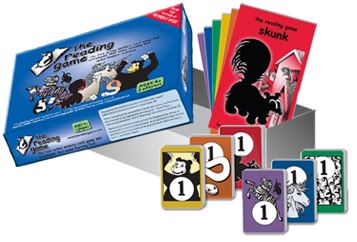
The Reading Game, which I received free in exchange for my review, is a fun memory-style card game created by the author of Wordly Wise.  Through an iterative learning process, children learn progressively more challenging sets of words in game sessions that result in winners almost continuously.  The fact that there is always a new winner means that kids don't get discouraged! The fact that the game is played in a familiar format, but with the addition of beautiful storybooks, means that kids have a great time.


The first thing you will notice about The Reading Game is its quality.  If you're anything like me, you get discouraged by how quickly the boxes on your kids' games seem to disintegrate, first splitting at the corners, and then ripping up the sides.  That is not going to happen with The Reading Game.  Everything from the box to the softcover storybooks to the laminated and damage-resistant cards is of the highest quality. This is a game that will stand the test of time.  If you happen to be fortunate enough to have younger readers in your home, you will be using this game quite frequently!


The Reading Game works by telling six stories, each only using 30 words.  By breaking these down into six sets of five, students learn the new words quickly through the frequent exposure gained by seeing them in the memory matching game.  To see a quick, one minute demonstration of how this game works, watch this video: How The Reading Game Works

While all of my children are proficient readers, they still liked playing this game.  A couple of them said that they would have loved learning to read this way.  I'll admit that, while I found the pace a little slow (which is good! I would be worried otherwise!), I definitely think that this game would help teach a child to read.  Of course, it is not the only reading instruction needed; a solid phonics-based approach is still, I think, a necessity for reading excellence.  However, in terms of giving kids confidence in recognizing sight words and making them feel that they can actually sit down and read a book, this game can't be beat.

The Reading Game is recommended for kids 4+ and is for two players.  The most important factor in using it, though, is not age, but reading readiness.  Also, there are many ways you could use the cards and books outside the context of the game, so don't hesitate to buy it just because you only choose games the whole family (or more than two members of the family) can play.  The game retails for $24.95.  For more information, visit their website and, as always, check out the Crew blog.

Monday, November 21, 2011

Review of Time Timer

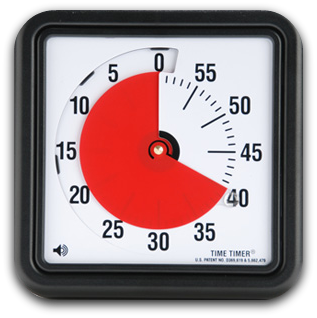
My latest product to review for the Crew is the niftiest little timer I've ever seen.  Its premise is so simple, but its effect on my son (all of my children, really) is so profound.  Time Timer (which I received free in exchange for my review) is a countdown timer, but it is unlike all other timers I've seen.  Designed by a mom to visually teach her child what "how much time is left" looks like, the Time Timer is wonderful for kids too young to tell time, special needs kids, and just about any other kids!

The Time Timer, like other timers, can be set for a certain amount of time, from which point it counts down to zero.  Unlike many other timers, though, the Time Timer is not digital and has quite a strong visual impact.  One can tell at a glance exactly both how much time has elapsed and how much time is left.

While this timer certainly has many potential uses, the obvious one for me is homeschooling.  One problem we seem to have is my kids spending too much time on one subject to the exclusion of others.  Some classes (like math) take as long as they take.  Others, though, like handwriting, really should have a set amount of time devoted to them and no more.  Enter the Time Timer! My kids actually fight over who gets to use it on a given day.  In fact, they quickly figured out that its use did not have to be confined to schooling only.  By the second day, my son was racing himself on various tasks (like cleaning his room), setting the Timer for what he thought was a reasonable time, and then trying to finish before time elapsed.  A timer that turns a chore into a game is a huge winner with me.

The beauty of the Time Timer is its  simplicity.  You manually turn the timer to the amount of time desired, and then watch the red disk disappear back into the white part of the timer, marking the movement of time. The audio signal that time has ended is quiet and unobtrusive, and it can be turned off altogether.

Time Timer is one of those products that really has to be tried to be understood, but once tried, you won't want to give it up! To see how Time Timer works, watch this neat video.  To read more about Time Timer, visit their website.  Finally, to purchase Time Timer, navigate to this page.  There are three sizes of Time Timer available, in addition to an iPad app.  The 3" timer, the one I received, is perfect for homeschool use, and retails for $30.00.  We loved the Time Timer! To read other opinions, check out the Crew blog.