For the last six weeks, we have been using a really neat product in our homeschool. To me, it is the kind of product that makes perfect sense for homeschoolers: it was developed by a homeschooling mom, it allows parents to utilize the very popular Classical and Charlotte Mason learning styles, and it is largely child-directed. Further, there is plenty of room for parents to adjust and adapt the cards to suit individual needs.
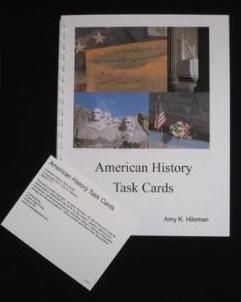
Because we are currently studying American History, the American History Task Cards were perfect for our family! When you order a set of cards from Creek Edge Press, you receive 40 cards like this one:
Each card contains essentially these same categories. The set is recommended for grades K-8, and it is obvious from a glance at this card that there is plenty of work for older and younger kids. The other great thing about the set is that there are activities for different kinds of learners. Two of my children were delighted with the poster option, while two of them always chose to write sentences rather than to make posters. Because I wanted to see how flexible these cards really were, I made some of the activities mandatory for all of my kids (7-10), including map work, timeline work, and copy work. I then let them choose how they would respond to the books we read together (three of them chose verbal narration while my oldest daughter chose written narrations under the "Literature" section of the card). In essence this set truly does offer complete flexibility.
More than any kind of actual curriculum, these cards should be viewed more as the best kind of alternative to textbook activities and Q&A. Further, because specific books are not required, these cards can easily fit into your existing curriculum. Each has a topic heading for encyclopedia research, so it would be easy just to file these cards into your current curriculum. Especially on days when you have not had time to plan or are not sure how to apply what you've learned, these cards are ideal.
The cards are supplemented by an instructional booklet, which includes a guide for using the cards, ideas for choosing suitable books, and tips for setting up an environment ideally suited to this kind of schooling.
In addition to American History, the cards are available for Ancient World, Early Modern, Geography and Culture, Medieval World and Modern World Histories, various sciences, Art and Music. I have to confess that I am quite excited about the Art and Music cards. They are definitely going on my curriculum list for the fall!
The American History Cards sell for $20, and other sets range from $18-$32, with complete sets of history and science available for under $100. My family loved these cards and plans to buy more. To see other opinions, head to the Crew Blog.
My reviews of homeschool curriculum, my ideas about homeschooling, and my attempts to live as the best possible Catholic wife and mother.
Wednesday, March 14, 2012
Sunday, March 4, 2012
Review of K5 Learning
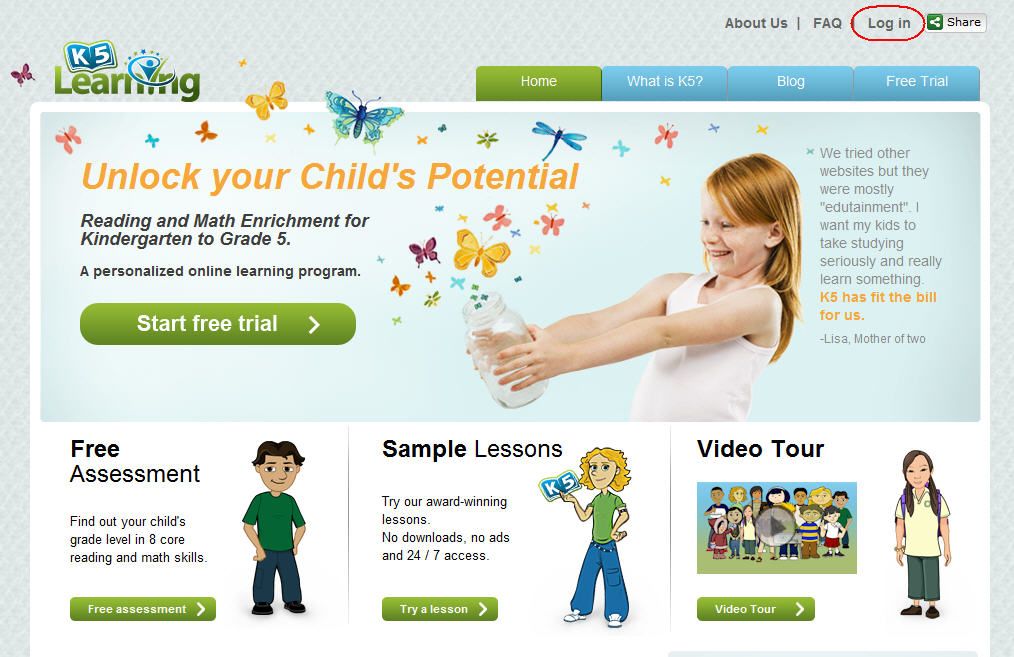
K5 Learning is an online supplemental curriculum. While it is not designed to be a complete curriculum in and of itself, it has a full spectrum of curriculum review, including math, spelling, reading, and math facts. Students begin K5 Learning by taking an assessment to see where they fit into the program.
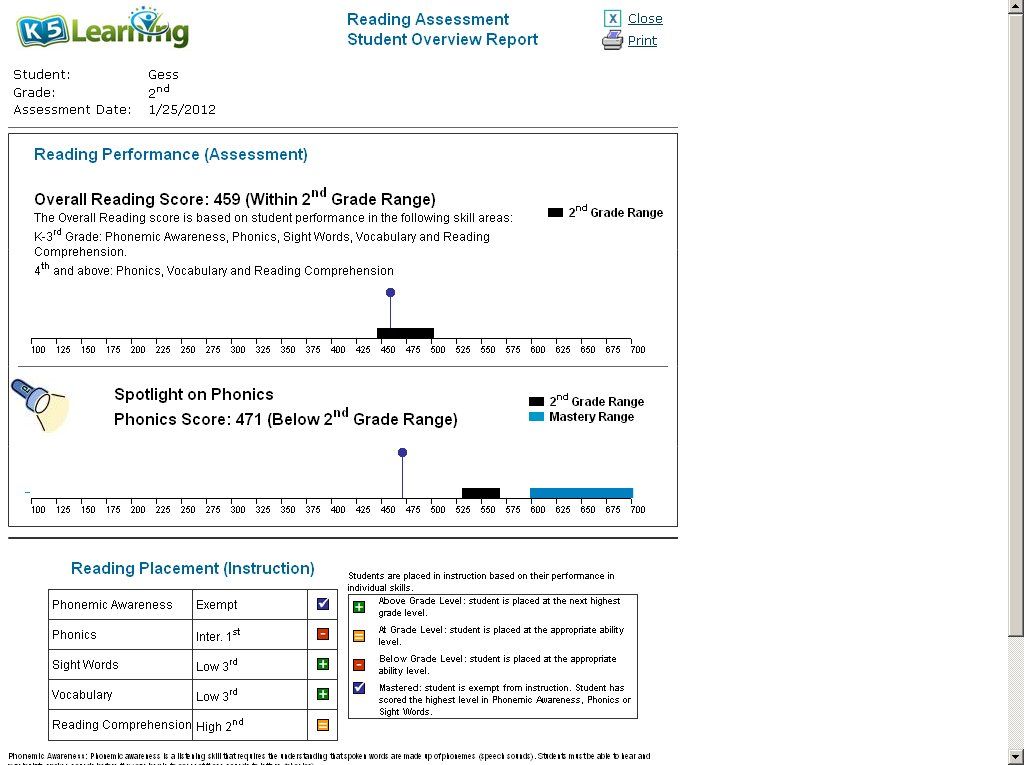
With K5 Learning's format and parental reports, you really do get the feeling that you are privy to an actual look at your child's skills. After all, for many homeschooling moms, we *think* we know what grade our children are in or what level their skills are at, but we are rarely ever completely sure (unless we have them take standardized tests, which are minefields in and of themselves for children who are poor test takers!). K5 Learning takes the guesswork out of that process. It is also excellent at isolating your child's weakness and filling in those gaps.
Complete with over 3,000 tutorials and activities, K5 Learning helps build your child's confidence by teaching them to work independently and allowing them to progress at their own pace. Because K5 Learning also provides lessons, instead of just practice exercises, you can rest assured that your child will be *learning*, and not just playing (as can be the problem with other supplementary programs!). The learning is accomplished in such a fun way and with such likable characters, though, that your child will not mind doing it at all!
K5 Learning is a great option for parents who are required to document their schools for the state. It allows you to print tangible evidence of the level your child is at, and it allows you to make sure that they are the grade you think they are (in case you are required to show that your child has actually learned and progressed in a given time). K5 Learning is available in the following subscriptions:
- Monthly: First child - $25, additional children - $15
- Yearly: First child - $199, additional children - $129
A subscription gives you access to all four of the site's programs.
We liked K5 Learning, but it's a little too expensive for our family, given that it is not intended to be used as a full curriculum. To find out how other Crew members are using K5 Learning in their schools, visit the Crew blog.
Thursday, March 1, 2012
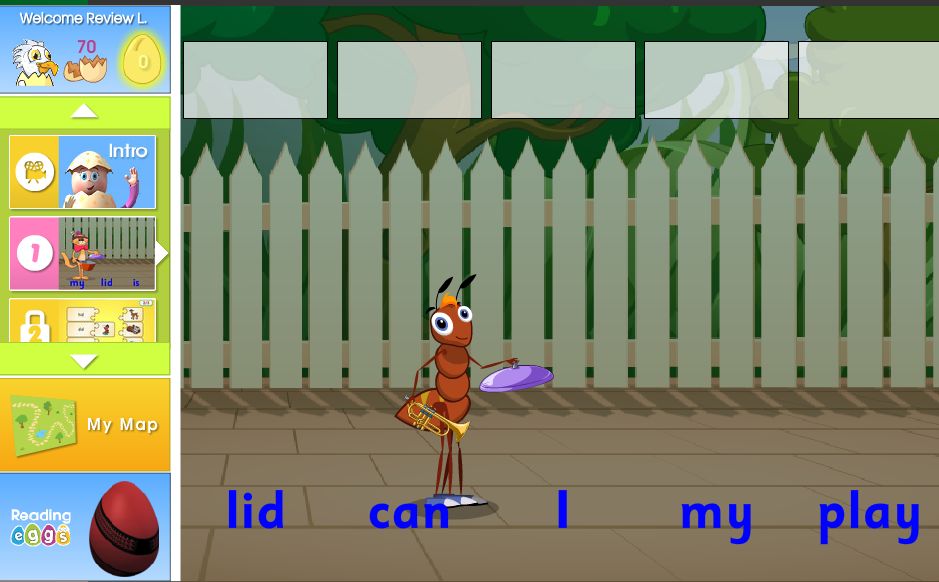
Review of Reading Eggs
The placement test is designed to assess a child's current level of reading and/or comprehension in order to begin his lessons at the correct point. The need for accurate placement is obvious to parents, as children who start a program at a level too advanced for them will lose heart. Those who start at a level too easy for them will get bored.
I have found in the past that I have a lot of trouble with online placement tests, or, more correctly, my children do. Unfortunately, my experience with Reading Eggs was no different. I have twin seven year-olds. My daughter is an accomplished reader and reads advanced chapter books. My son, though, while he can read, is not what I would call proficient. I was, therefore, excited to begin Reading Eggs to try to catch him up to his twin. Whether because he does not do well in a placement test situation, or because his skills are not consistent in any one area, he scored much lower on the test than I would have expected (or, rather, he was started at a level that seemed too low to me given what I know about his reading ability).
I gamely started him where he was supposed to be, but he quickly became bored. He already knew everything that he was being taught.
Thinking that perhaps he just hadn't tested well, I tried him in the reading comprehension section. Because we haven't done anything like this before, he didn't seem to understand what was required of him. When "reading comprehension" takes the form of narration, my son knocks it out of the park. His memory for details is wonderful. In this format, though, he just didn't seem to understand. He kept choosing the wrong answer and then getting more and more upset. We didn't get much use out of our subscription.
I don't want to imply that this program is not a good one. I think for a child just starting to read, still learning basic phonics and sight reading, this program would be excellent. The format is fine, the characters are likeable, and the pace of the program seems good. If your child can read, though, but can not yet "get" reading comprehension, then you may find that there is no good fit for you here.
Reading Eggs is available as a free 14 day trial, or can be purchased as a subscription starting at $9.95/month. Other plans are available.
Reading Eggs didn't end up working for our family, but that doesn't mean that it won't work for yours! You know my experience with the program. Visit the Crew blog to learn others'.
Thursday, February 23, 2012
Review of Apologia's Who Am I?
Apologia's Who Am I curriculum includes a gorgeous and glossy hardcover textbook, a coil-bound 250 page notebooking journal, a beautiful 64 page coloring book, and an audio CD, all of which I received free in exchange for my review. In essence, the Who Am I curriculum gives students a biblical framework for understanding their purpose in this world. From my Catholic perspective, this curriculum fleshes out the Baltimore Catechism question of "Why did God make me?" "To know, love, and serve him this world and be happy with him in the next." Who Am I tells children how to know, love, and serve God on a very personal level - through a correct understanding of their own self-image in the eyes of God.
Specifically, each chapter asks a question (such as "What are we doing here?", "What will you make today?", How will you run the race?", and "What kind of fruit are you growing?", among others. Each lesson is then further broken down into these categories:
- The Big Idea
- What You Will Need
- Short Story
- Think About It
- Words You Need to Know
- Hide it in Your Heart
- Integrated Learning
- What Should I Do?
- Prayer
- Worldviews in Focus
- What's the Difference?
- House of Truth
A sample lesson plan idea is also included in the text, allowing each lesson to take three days at two days a week of study.
I'll admit that I walked into this curriculum unsure as to whether it would work for my kids, given that we are Catholic and Apologia is, obviously, a noted Protestant publisher. However, just as with Apologia's science curriculum, there is nothing in this program that is hostile to Catholicism. In fact, in one of the stories used to illustrate the points, a Catholic church is visited by a non-religious boy, causing him to question his upbringing. While this curriculum is not appropriate as an all-inclusive Bible or Religion curriculum for a Catholic homeschooler (because of the Catholic Church's inclusion of Tradition with Scripture as a means for understanding theology), it can absolutely be used as a supplement.
The curriculum allows children to understand the difference between Christianity and other major worldviews, including Mormanism, Buddhism, Humanism, Judaism, Hinduism, New Age, and Communism. This is a great way for kids to learn about other beliefs in a context that allows them to see how those beliefs are contrary to their own. Even the youngest children can begin to learn apologetics in this format.
The notebooking journal is the same high quality as Apologia's science notebooking journals, and it includes a 48-day lesson plan for completing the curriculum. Whether parents choose to use it once, twice, or three times a week (or more!), the lessons are planned 100%. Each lesson includes pages that correspond directly with the parts noted in the bulleted list above, along with games and blank pages. There are minibooks in the back for those people who have more of a lapbooking/notebooking approach. As with Apologia's science journals, I have to say that these journals are worth the price. Could you replicate much of this on notebook paper just following the text? Sure, but why would you when the notebooking journal has taken every bit of work out of lesson planning and teaching. It also provides a great archival record of the course.
The Who Am I curriculum is available from Apologia, and they retail for the following prices:
- Textbook - $39.00 (See Sample HERE)
- Notebooking Journal - $24.00
- Coloring Book - $8.00 (See Sample HERE)
- MP3 CD - $19.00
I have to admit that I was surprised by how much I loved this curriculum. For other views, see the Crew blog!
Wednesday, February 22, 2012
Review of Beeyoutiful
One of the neatest products I have received free for the purposes of review came for a company with a great name: Beeyoutiful. For the past month, I have been happily using the Beeyoutiful All Natural Lip Moisturizer (B.A.L.M.) and the Winter Breeze Vapor Rub. Beeyoutiful is a company that makes all-natural health and beauty products, including products for joint health, circulatory support, digestion, hormone support, and more. While I haven't tried any of Beeyoutiful's other products yet, I can enthusiastically recommend the B.A.L.M. and Vapor Rub - two essentials to have on hand during winter.
One of my (many) OCD quirks is the need to put on chapstick before I go to bed at night. I can't go to sleep unless I do. As soon as I received the B.A.L.M. in the mail, though, it took the place of the chapstick -- and I love it! Lightly scented with peppermint, the B.A.L.M. feels very light and smooth on your lips, but it lasts and lasts. The B.A.L.M. is also available in orange, and they each sell for $3.00. That's about the same price as another popular brand, and I definitely like the B.A.L.M. better!
Ordinarily, I would not have been able to give the Vapor Rub a fair trial, as my children are ridiculously healthy. For the last week, though, we have all been battling what feels like the plague, so the Vapor Rub got a thorough test drive.
The Vapor Rub comes in a 4 oz. jar and has coconut oil, olive oil, and beeswax, along with camphor, eucalyptus, menthol, wintergreen, and tea tree oils. It's like that other rub, but so much nicer! Like the B.A.L.M., the Vapor Rub is light and fragrant and, most importantly, it works! There is no decongestant like a natural decongestant. With a consistency that is far less goopy than the other rub, Winter Breeze is something you don't mind slathering on your chest or under your nose. At $18.00, it is kind of pricey for a rub, but if you're going to spend extra money on anything, then a product that makes you feel better when you are sick is a good way to spend it.
I am not an all-natural mom. I don't use the naturalness of ingredients as a baseline criteria for purchasing them. However, if there are all-natural products that out perform others, I will definitely choose to use them. This is the case with Beeyoutiful. If you insist on all-natural products, you can't miss this line. If, like me, you like all-natural, but you value performance more, you can't miss this line! I'm a fan...to see what others thought, read the Crew blog.
One of my (many) OCD quirks is the need to put on chapstick before I go to bed at night. I can't go to sleep unless I do. As soon as I received the B.A.L.M. in the mail, though, it took the place of the chapstick -- and I love it! Lightly scented with peppermint, the B.A.L.M. feels very light and smooth on your lips, but it lasts and lasts. The B.A.L.M. is also available in orange, and they each sell for $3.00. That's about the same price as another popular brand, and I definitely like the B.A.L.M. better!
Ordinarily, I would not have been able to give the Vapor Rub a fair trial, as my children are ridiculously healthy. For the last week, though, we have all been battling what feels like the plague, so the Vapor Rub got a thorough test drive.
The Vapor Rub comes in a 4 oz. jar and has coconut oil, olive oil, and beeswax, along with camphor, eucalyptus, menthol, wintergreen, and tea tree oils. It's like that other rub, but so much nicer! Like the B.A.L.M., the Vapor Rub is light and fragrant and, most importantly, it works! There is no decongestant like a natural decongestant. With a consistency that is far less goopy than the other rub, Winter Breeze is something you don't mind slathering on your chest or under your nose. At $18.00, it is kind of pricey for a rub, but if you're going to spend extra money on anything, then a product that makes you feel better when you are sick is a good way to spend it.
I am not an all-natural mom. I don't use the naturalness of ingredients as a baseline criteria for purchasing them. However, if there are all-natural products that out perform others, I will definitely choose to use them. This is the case with Beeyoutiful. If you insist on all-natural products, you can't miss this line. If, like me, you like all-natural, but you value performance more, you can't miss this line! I'm a fan...to see what others thought, read the Crew blog.
Tuesday, February 7, 2012
Review of Celestial Almanack
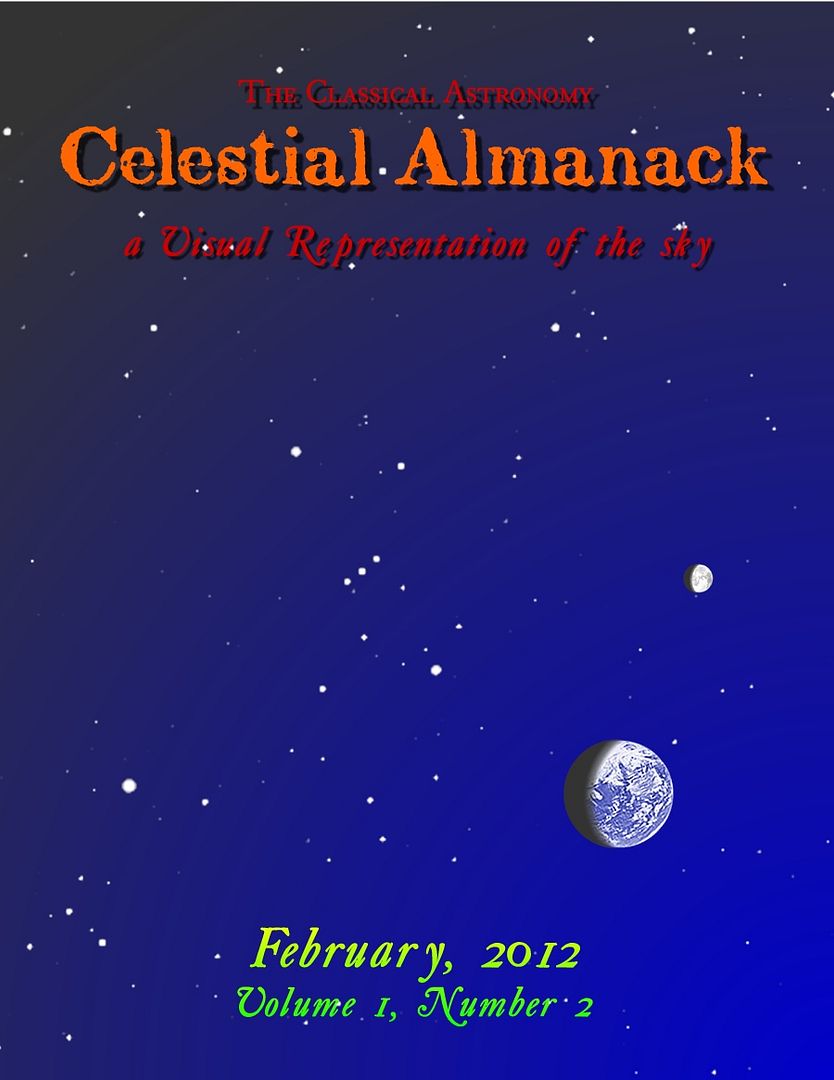
For the first time since I began reviewing products, we received a product to review which made my husband say wow. That's an endorsement! Through the Crew, I received the February edition of Classical Astronomy's Celestial Almanack free in exchange for my review. I already know that this is a product I will purchase again!
This product is so comprehensive and cool that it is hard to describe but, I'm told, that is my job, so I'll try! The first really neat thing you'll notice about this Almanack is its faithfulness to Benjamin Franklin's Poor Richard's Almanack. The 18th century feel of the typeset and the verbiage made my heart warm to this product immediately! The second really neat thing you'll notice is just how much Jay Ryan has managed to fit into this 21 page study.
The Almanack begins with a discussion of Leap Year and the month of February. It then gives a brief history of how man has reckoned time and the evolution of the calendar. The next page of the Almanack is a day-by-day iteration of February with notable events and the phase of the moon noted. The rest of the Almanack consists of a description of how the night sky appears in February with detailed maps of various constellations and directions on how to identify the various features of the night sky.
Mr. Ryan's love for his subject comes through on every page. His enthusiasm and excitement are contagious. Best of all, he doesn't assume that everyone has a high powered telescope. If you do, consider yourself incredibly lucky! For those who own only a small telescope, though, there are plenty of celestial entities to see. If you don't own a telescope at all, don't feel dismissed. Much of what Mr. Ryan describes is visible to the naked eye and, with his excellent tutelage, you will see more than you ever thought possible!
You don't have to be an astronomical devotee to find the things Mr. Ryan talks about. In fact, he has diagrams of everything he discusses (from the perspective of a February sky) so that anyone can find what he's talking about. I learned more about astronomy from this jam-packed Almanack than I ever have before. I will definitely be buying next month's edition!
If I had one complaint about the Almanack, it is that I couldn't print it because of all the diagrams - I think it would have used a whole cartridge of black ink! Having said that, though, I wouldn't change a thing. Those diagrams are what make the Almanack so special and such a great deal. For those who don't like reading documents on the computer, though, the printing cost is something to consider.
Because I received a free download of the Almanack, I didn't know at first how much it cost. I was, quite literally, shocked to find out that it only cost $3.99. I would place its value at easily three times that amount. I simply can't describe how much information is in this one little product. If you wanted to do astronomy as your science you could, with only this one monthly booklet. (You don't have to rely solely on that, though, since Mr. Ryan also publishes a homeschool astronomy curriculum, available on his website.) The Celestial Almanack is available from CurrClick for $3.99. January is also available, and March is forthcoming.
My family are huge fans of the Celestial Almanack. To find out how other Crew members like the Almanack, visit the Crew blog.
Monday, February 6, 2012
Review of Math Rider...again!
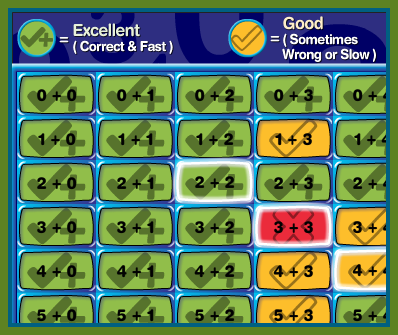
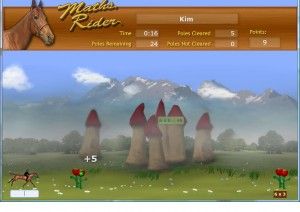
The premise of Math Rider is simple: a student (or his parent) can choose between addition, subtraction, multiplication, or division, and then further refine the choice by selecting whether to work on easy, medium, or hard facts. So, for example, a student can practice addition facts from 0-6. When these facts are mastered, he can move on to the medium difficulty facts.
The genius of Math Rider is in its "quest" format. Following a story introduction, a student assumes the character of a horse rider. By riding through the countryside and solving fact problems, students come ever closer to completing their quest. If a student misses a problem, the answer will be given them and that fact will show up again very soon after.
The best way to experience Math Rider is to watch the preceding video and then navigate to their website for a free trial. If you have a child who struggles with math facts, then a program like this is essential. In this digital age, flashcards don't seem to pack the same punch they once did! Math Rider, though, combines a story with fact practice, and students can see the extent of their progress any time. Best of all, with the newest version, parents can now easily view their child's statistics, progress, and overall mastery, making it simple to keep track of where each of your children is in their quests.
You can download Math Rider for $37. For that amount, you can use Math Rider with all of your kids in perpetuity. If you're not sure whether or not Math Rider is the fact practice software for you, fear not! You can enjoy a free trial of the full-featured software before you commit to buying. You truly have nothing to lose. One warning: if you let your children begin a quest during your free trial, you can pretty much guarantee that they will insist you buy the full software. We all like to finish what we start!
To find out about Math Rider and its free trial, surf on over to their website. To read what other Crew members thought about Math Rider, visit the Crew blog. Math Rider is once again a favorite in my house - give it a try in yours!
Subscribe to:
Posts (Atom)